

Business
Advisory
You Know Something Isn’t Working. The Harder Part Is Figuring Out What’s Really Causing It.
A business can be busy, growing, and successful while still not performing as well as it should.
Maybe revenue is increasing but profitability isn’t. Maybe you’re having trouble finding or keeping good people. Maybe sales, estimating, and production are not working together smoothly. Processes that worked when the company was smaller are beginning to break down.
Or maybe things seem to be going reasonably well—as long as you are there.
You are still the person solving the problems. There may be certain times of day, meetings, or parts of the operation where you feel you simply have to be present because too many decisions, questions, and exceptions still depend on you.

Sometimes the first sign that something needs to change is realizing that the business should be able to function better without you constantly holding it together.
That is where an experienced outside perspective can help.

Why choose ViewPoynt?
Deep Expertise
I possess a deep understanding of and relatable experience in the small business sector. As someone who has personally navigated the tests of business ownership in the challenging green industry, I bring practical insights that can elevate your business with a second set of eyes.
The Power of Simplification
My unique talent lies in finding efficiency across various business domains — from sales and accounting to production processes and communication. My goal will be to simplify complex systems and foster an environment where employees thrive and business practices are streamlined.
An Eye for Talent
Successful hiring is one of the most important keys to any business's success. It goes beyond placing ads or where to find talent. This involves strategic thinking, aligning the personality and brain operating principles of an individual with the tasks and operational needs to succeed in any given position.
In spearheading a highly successful landscape architecture design-build firm, one of my core proficiencies lay in identifying, hiring, and nurturing exceptional talent and bringing a strategic and insightful approach to the art of personnel selection, ensuring that businesses not only find the right individuals but also create teams that excel together.
Where an Outside Perspective Can Help
Sometimes the problem is obvious. Other times, the owner simply knows the business should be working better than it is.
Common areas include:
· Better profitability and stronger margins
· Better hiring, retention, and role fit
· More efficient operations and business processes
· Better alignment between sales, design, estimating, and production
· Less dependence on the owner for day-to-day decisions
· Stronger people, systems, and leadership to support growth
You may already know exactly where you need help.
Or you may simply want an experienced second set of eyes to help determine what is really driving the problem and where change can make the greatest difference.


The business could only grow beyond a certain point if the ability to think, make judgments, and solve problems grew beyond me as well.
A Lesson I Learned Building My Own Business
Most business owners are pretty good problem solvers. I would put myself in that group.
For a long time, that worked well. I had a good team. They took direction, followed through, built nice projects, and we had happy customers.
But over time, I realized too much of the problem solving still depended on me.
Part of the reason was simple: I liked solving problems. For a while, it was easier to step in, figure something out, and keep things moving.
As the business grew, that model stopped working.
I did not just need more people. I needed people throughout the organization who could think, make judgments, solve problems, and learn without everything coming back to me.
That changed the way I looked at hiring.
In many cases, I would rather put someone in a role with less experience whose natural way of thinking aligned well with the position, who could solve problems and liked to learn, than someone with a stronger resume who lacked the judgment, attention to detail, or problem-solving ability the role required.
Experience matters. But experience alone does not tell you how someone will perform when they face a situation they have not seen before.
The Problem You See May Not Be the Problem You Need to Solve
Business owners usually know where they are feeling the pain. What is harder to determine is why.
“I can’t find good people” may actually involve your culture, or how people are recruited, selected, trained, managed, compensated, and placed into roles.
A profitability problem may begin with estimating, sales, production efficiency, overhead, pricing, or incomplete information about where money is actually being made or lost.
“Customers won’t pay more for that.”
Maybe they won’t. But the issue may also be how value is communicated, which customer is being targeted, or what product, service, or design is being offered.
A production problem may have started much earlier with how the project was sold, designed, estimated, purchased, or scheduled.
An overwhelmed owner may not simply have too much work. The organization may still depend on that owner for decisions that should happen elsewhere.
The problem you see may not be the problem you need to solve.
My role is to work with you to separate the symptoms from the underlying causes.

I Look at the Business as a Whole
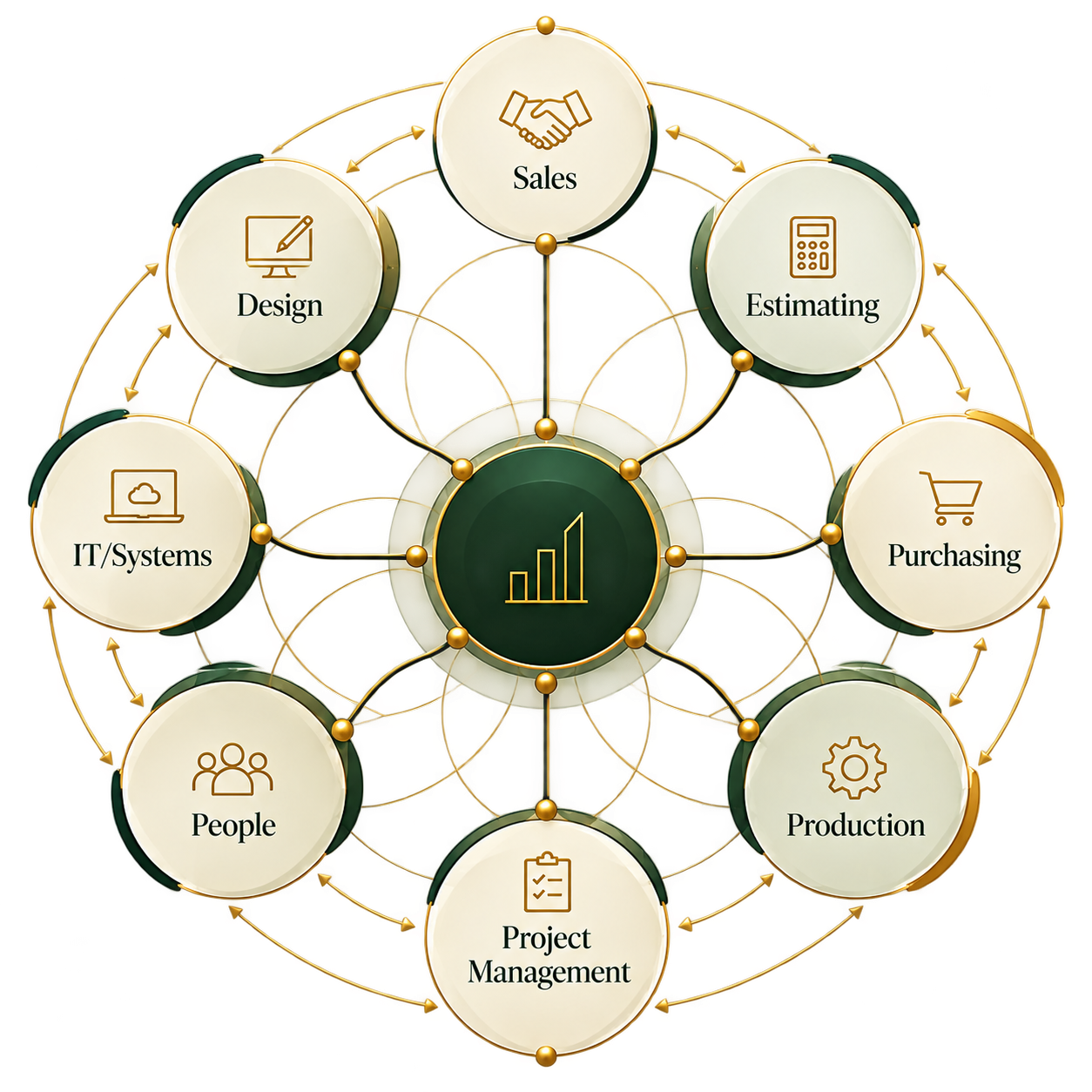
Every business is a series of interconnected processes.
In a design-build business, sales intersects with design. Design intersects with estimating. Estimating intersects with purchasing and production. Production intersects with project management, staffing, accounting, customer communication, and profitability. IT and business systems support nearly all of them.
When those connections work well, information and responsibility move efficiently.
When they do not, friction begins to appear.
That friction may show up through poor handoffs, incomplete information, duplicated effort, mistakes, rework, employee frustration, slower decisions, lower margins, or greater dependence on the owner.
My approach is to immerse myself in the business long enough to understand how those processes actually work—not just how they are supposed to work.
The goal is to identify where the friction begins, what else it affects, and where changes can improve the performance of the business as a whole.
Where Business Owners Commonly Need Help
The issues an owner has in their organization are rarely isolated.
A profitability problem may involve estimating. A personnel problem may actually be a role-fit or management problem. An operations problem may begin with the way work was sold. Growth often exposes weaknesses that were easier to manage when the company was smaller.

01
Profitability & Margins
Being busy does not necessarily mean being profitable.
Revenue can increase while margins stay flat or decline. Profit may be lost through estimating, pricing, production inefficiency, purchasing, overhead, rework, or simply not having good enough information about where money is being made or lost.
Sometimes the issue is an assumption such as, “Customers just won’t pay more for that.”
Before accepting that conclusion, it is worth understanding whether the issue is price, value communication, customer selection, or the offering itself.
The objective is not simply to sell more. It is to understand what is driving profitability and where changes can have the greatest impact.


02
Operations & Business Processes
As companies grow, processes that worked when the business was smaller often stop working as well.
Responsibilities become less clear. Information gets lost in handoffs. Mistakes, rework, delays, and repeated questions consume time.
Often, the owner becomes the person who fills the gaps.
I look at how work moves through the business and where better business processes, clearer responsibilities, stronger accountability, or improved systems can increase operational efficiency.


03
Sales, Design, Estimating & Production
In a design-build business, these functions are tightly connected.
A project sold one way but estimated another creates problems. A design decision can affect labor, purchasing, scheduling, and margin.
Production may appear to be the problem when the real issue began much earlier in sales, design, or estimating.
I look at the path from the initial opportunity through design, estimating, contracting, purchasing, production, billing, and completion to see where information, expectations, or responsibility begin to break down.


04
People, Hiring & Role Fit
“I can’t find good people” is a common frustration.
Sometimes the labor market really is difficult. But the larger issue may involve culture, hiring, training, management, compensation, expectations, or role fit.
Is the way that person naturally thinks well aligned with what the position requires?
Different roles call for different strengths.
Accounting often rewards a systematic approach, comfort with routine processes, and strong attention to detail. A successful designer or salesperson may need a different mix of creativity, adaptability, communication, and relationship skills.
A capable person with a strong resume can absolutely struggle when they are in the wrong seat.
Hiring problems, employee turnover, and employee retention are not always simply about finding better employees. Sometimes the issue is how well the person, the role, the manager, and the culture fit together.


05
Leadership & Owner Dependency
Sometimes the business is functioning reasonably well—but only because the owner is constantly keeping it on track.
Managers wait for decisions. Employees bring exceptions back to the owner. Problems that should be solved elsewhere continue to land on the same desk.
Eventually, that limits both the owner and the company.
Reducing owner dependency may involve stronger managers, clearer responsibilities, better accountability, different people, or changing how decisions are made.
The objective is not to make the owner unnecessary. It is to allow the owner to spend more time doing the things where they add the most value.


06
Growth & Organizational Change
Growth has a way of exposing weaknesses.
The people, systems, and processes that supported a company at one size may not support it at the next.
The owner may know where they want the company to go without yet knowing what the organization needs to become to get there.
That may require different leadership, roles, systems, information, or processes—and deciding what needs to change first.
Growth is not only about adding revenue. It is about building an organization capable of handling what comes next.
I bring an outside perspective, experience from running my own business, and a different set of questions.
Together, we compare what leadership believes is happening with what is actually happening in practice.
Advisory or More Involved Leadership
Some businesses primarily need an experienced business advisor to help the owner challenge assumptions, evaluate choices, and make better decisions.
Others need someone who can become more involved for a period of time.
That may mean working alongside ownership and leadership in operations, sales, marketing, hiring, accountability, organizational development, profitability, or implementation.
These are executive-level functions, but the business does not necessarily need another full-time executive.
Fractional leadership allows the level of involvement to fit the actual needs of the company.
In one business the need may be operations. In another it may be sales, marketing, hiring, organizational development, or simply helping leadership move decisions into action.
The role should fit the needs of the business—not the other way around.
Where My Experience Is Most Relevant
My experience is especially relevant where sales, design, estimating, people, production, project execution, and customer expectations all have to work together.

Landscape & Design-Build Businesses
This is where my experience runs deepest.
I spent 30 years building and operating my own landscape architecture design-build company across sales, design, estimating, operations, staffing, project delivery, customer relationships, and profitability.
At the same time, most of the core business processes in a landscape design-build company are very similar to those in other construction-related and home-service businesses: generating leads, selling work, estimating, purchasing, scheduling, managing people, producing the work, billing, and maintaining customer relationships.
The industry may be different, but many of the underlying business processes—and the problems that develop when those processes do not work well together—are much the same.

Construction & Specialty Contractors
Construction companies and specialty contractors depend on estimating, scheduling, purchasing, labor, project management, communication, and execution working together.
This makes construction business consulting and contractor advisory another strong fit for my experience.

Remodeling & Other Design-Build Businesses
Kitchen and bath remodeling, general remodeling, outdoor living, and other design-build businesses face many of the same challenges I dealt with firsthand.
Sales, design, estimating, purchasing, production, project management, and customer expectations have to stay aligned from the first conversation through completion.
Home Services & Related Owner-Led Businesses
Many owner-led businesses face similar challenges as they grow: hiring the right people, building better systems, improving sales, maintaining margins, creating accountability, and reducing dependence on the owner.
The industry may be different, but many of the underlying business issues are the same.
My perspective comes from more than four decades of industry experience, including 30 years building and operating my own successful landscape architecture design-build company.

An Experienced Second Set of Eyes
You may already know exactly where you need help.
Or you may simply know the business should be performing better and want an experienced second set of eyes to look at what you are doing, how you are doing it, and where improvement may be possible.
You do not have to diagnose the business before asking for help.
Sometimes the most valuable starting point is having someone from the outside look at the company without the assumptions that naturally develop when you have been inside it every day.
My role is to work with you to understand what is really happening, identify where change can make the greatest difference, and determine what should happen next.
ViewPoynt is based in St. Louis, Missouri, and works with owner-led businesses throughout Missouri, nearby Illinois, and select companies beyond the region.